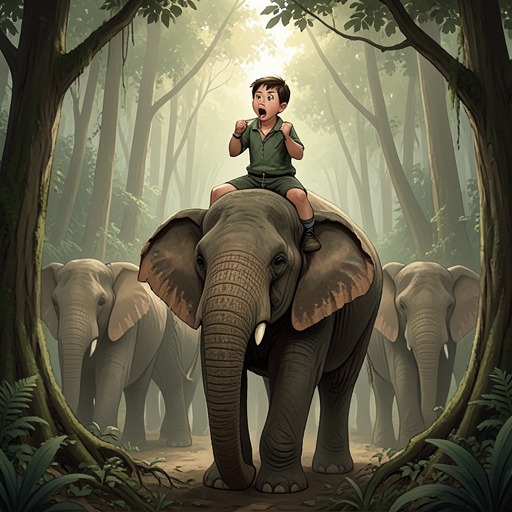
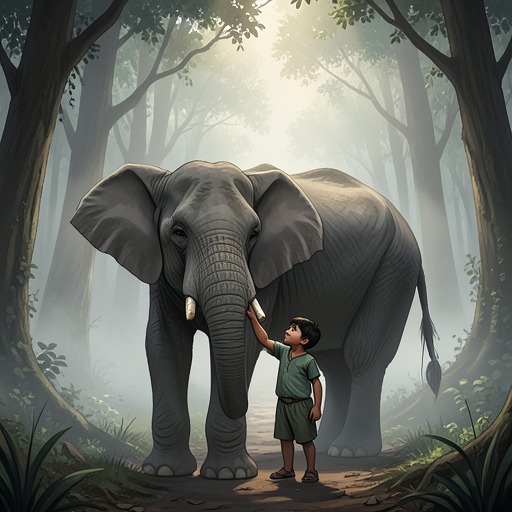
Toomai of the Elephants' initiation
The Jungle BookToomai of the Elephants' initiation marks Little Toomai's passage from an ambitious camp child into a publicly recognized forester whose authority rests on an experience no human had previously claimed: seeing the elephants dance at night, alone, in the hidden heart of the Garo hills. The event joins eyewitness knowledge to communal ritual. Little Toomai returns exhausted and nearly unconscious, but the truth of his vision is tested, accepted, and finally made permanent through naming, blood-marking, prophecy, and the Salaamut of the Keddah.
The Return from the Hidden Dance
Little Toomai reaches Petersen Sahib's camp two hours after the elephants have begun trumpeting. Pudmini is mired to the shoulders, Kala Nag is painfully footsore, and Little Toomai's face is gray and pinched, with leaves in his hair and dew-soaked clothing. He nevertheless tries to salute Petersen Sahib and announces that he has seen the elephant dance before sliding from Kala Nag's neck in a dead faint. The physical condition of both child and elephant makes the claim costly rather than ornamental: the journey has left visible evidence on their bodies.
His collapse does not end the episode. Within two hours he is resting in Petersen Sahib's hammock with the shooting-coat beneath his head, warm milk, brandy, and quinine inside him. The scarred hunters gather three deep before him, looking at him as though he were a spirit, while he recounts the experience in the short, emphatic manner of a child. He invites verification rather than asking for unquestioning belief: if any word is false, men should follow the track and inspect the dance-room themselves. He specifically predicts that the elephants have trampled open more space and that many tracks will lead to it, while identifying Kala Nag as too weary to have made the journey without consequence.
Verification by the Hunters
While Little Toomai sleeps through the afternoon and into twilight, Petersen Sahib and Machua Appa follow the elephants' trail fifteen miles across the hills. Petersen Sahib has spent eighteen years catching elephants and has found only one comparable dance-place before; Machua Appa, with forty-five years of experience following elephants, recognizes the clearing immediately. The packed earth shows that the place has been used for the dance, and seventy tracks crossing the river confirm the scale of the movement.
The evidence includes a precise physical trace. Pudmini's leg-iron has cut the bark of a tree, proving that she reached the clearing as Little Toomai described. Machua Appa does not merely accept the child's confidence; he tests the ground, counts the tracks, and matches the marks to the participating elephants. Yet verification does not make the mystery ordinary. Petersen Sahib and Machua Appa remain astonished because the ways of elephants exceed the understanding of both black and white men. The clearing therefore validates Little Toomai's report while preserving the elephants' independence from human explanation.
Machua Appa's reaction gives the discovery its full importance. After following elephants for forty-five years, he has never heard of a human child seeing what Little Toomai has seen. His bewilderment becomes an admission that the child has crossed a boundary separating human knowledge from the elephants' hidden life. The event is not presented as a successful act of capture or control; it is an encounter with an animal society whose secret ritual remains beyond the hunters' wit.
From Witness to Initiate
The communal response begins with practical generosity. Petersen Sahib orders two sheep, fowls, and double rations of flour, rice, and salt for the camp, understanding that the discovery requires a feast. Big Toomai arrives from the plains after searching for his son and his elephant, but he looks at them with something like fear, as though the experience has altered both beyond the ordinary expectations of a father and a working elephant-handler.
Little Toomai is then marked on the forehead with blood from the breast of a newly killed jungle-cock. The mark identifies him as a forester, initiated and free of all the jungles. His new status is thus made visible on the body. It does not arise solely from his birth, his work around Kala Nag, or his father's occupation; it is conferred by witnesses who recognize that he has entered a domain of knowledge ordinarily closed to human beings.
The central act is Machua Appa's renaming of the child. Holding him high above his head, Machua Appa declares that he shall no longer be called Little Toomai, but Toomai of the Elephants, as his great-grandfather was called before him. The name converts an astonishing personal sight into a public identity and connects the child to an inherited line of elephant knowledge. His initiation is therefore both exceptional and genealogical: he is honored for seeing what no human had seen, yet the honor also restores an older name and places him within a tradition.
The New Name and Its Promised Future
Machua Appa's proclamation gives the initiation a future-facing dimension. He predicts that Toomai of the Elephants will become a great tracker, capable of following new trails, stale trails, and mixed trails with a clear eye. He further imagines the child moving beneath the bellies of wild tuskers in the Keddah without harm and surviving even a fall before a charging bull elephant because the bull will recognize who he is.
These promises do more than praise Little Toomai's courage. They assign him duties and powers within the working world of the elephant catchers. His future is imagined through tracking, roping, and intimate proximity to dangerous elephants, but the language also grants the elephants judgment: the charging bull is expected to know him and spare him. The initiation thus establishes a reciprocal bond rather than a simple human mastery over animals.
Machua Appa then addresses the elephants as lords and calls on them to honor the child. He names Pudmini, Kala Nag, and other elephants in the line, linking Little Toomai's recognition to those who carried, accompanied, or encountered him. The ceremony moves between human speech and animal response, treating the elephants as participants whose acknowledgment matters even though their intentions remain partly unknowable.
The Elephant Salute and Narrative Significance
At Machua Appa's final summons, the entire line of elephants raises its trunks until the tips touch their foreheads and gives the Salaamut of the Keddah, a crashing trumpet-peal associated with the highest ceremonial honor. The salute makes the initiation collective and audible. Little Toomai is not merely praised by hunters around a fire; the elephants themselves become the visible and sonorous presence before which the new name is proclaimed.
The scene reverses the ordinary hierarchy of the elephant camp. Humans capture, chain, drive, track, and rope elephants, while Little Toomai's achievement comes from entering their hidden world as a witness rather than subduing them. The human community confers the name, but the elephants' salute completes its authority. The ceremony also echoes other communal systems in the book, where identity is established through inspection, naming, bodily signs, and acceptance by a group rather than through private self-assertion alone.
The ending states the decisive fact plainly: Little Toomai has seen what no human had seen before—the night dance of the elephants, alone and deep within the Garo hills. His initiation therefore changes not only what others think of him but what kind of knowledge the community is willing to recognize. A child who might otherwise remain on the margins of the camp becomes Toomai of the Elephants, a named intermediary between human observers and an animal people whose most secret gathering remains their own.